The Room You Can't Curate
I have to make an argument, hear a counterargument, lose a vote, and then sit next to the person who beat me at dinner. And then come back the next morning and do it again.

Scott Galloway said something a while ago that I keep chewing on. This is notable because I find Galloway frequently obnoxious (though I begrudgingly admire that he seems to cultivate this purpose and with considerable success). On a episode of On with Kara Swisher, while promoting his book Notes on Being a Man, he made an observation I haven't been able to shake.
He was talking about the collapse of "third spaces" — the physical places where men (but, you know, also people in general) used to build relationships through proximity and shared obligation. Fraternal organizations, civic clubs, union halls, churches. Spaces where you were in the room with people you didn't choose, couldn't mute, and had to maintain community with even when they drove you out of your mind. Those spaces are mostly gone. What replaced them is algorithmic sorting: you pick your feed, your community, your information environment. Disagreement becomes optional. And when disagreement becomes optional, the muscle for it atrophies.
I think most physicians reading this will recognize the phenomenon, even if they've never framed it in those terms.
Medicine has its own version of this collapse (unless I guess you're willing to pay a goodly chunk of change for an online physicians' lounge). We silo by specialty, by institution, by geography, by payer mix. We interact with the healthcare system primarily as people it happens to — not as people who shape it. We attend our subspecialty conferences, read our subspecialty journals, talk to our subspecialty colleagues, and then express shock when the policies governing our practice seem to have been designed by someone who has never met a patient. The feedback loop is broken, and part of the reason it's broken is that we've opted out of the rooms where the loop gets repaired.
Mostly because I answer this question from people ALL THE TIME, I want to make a case for a specific, unsexy, frequently maddening antidote: organized medicine. Not because it's perfect — it is emphatically not — but because it is one of the last remaining professional rooms you can't curate.
What "The Room You Can't Curate" Actually Looks Like
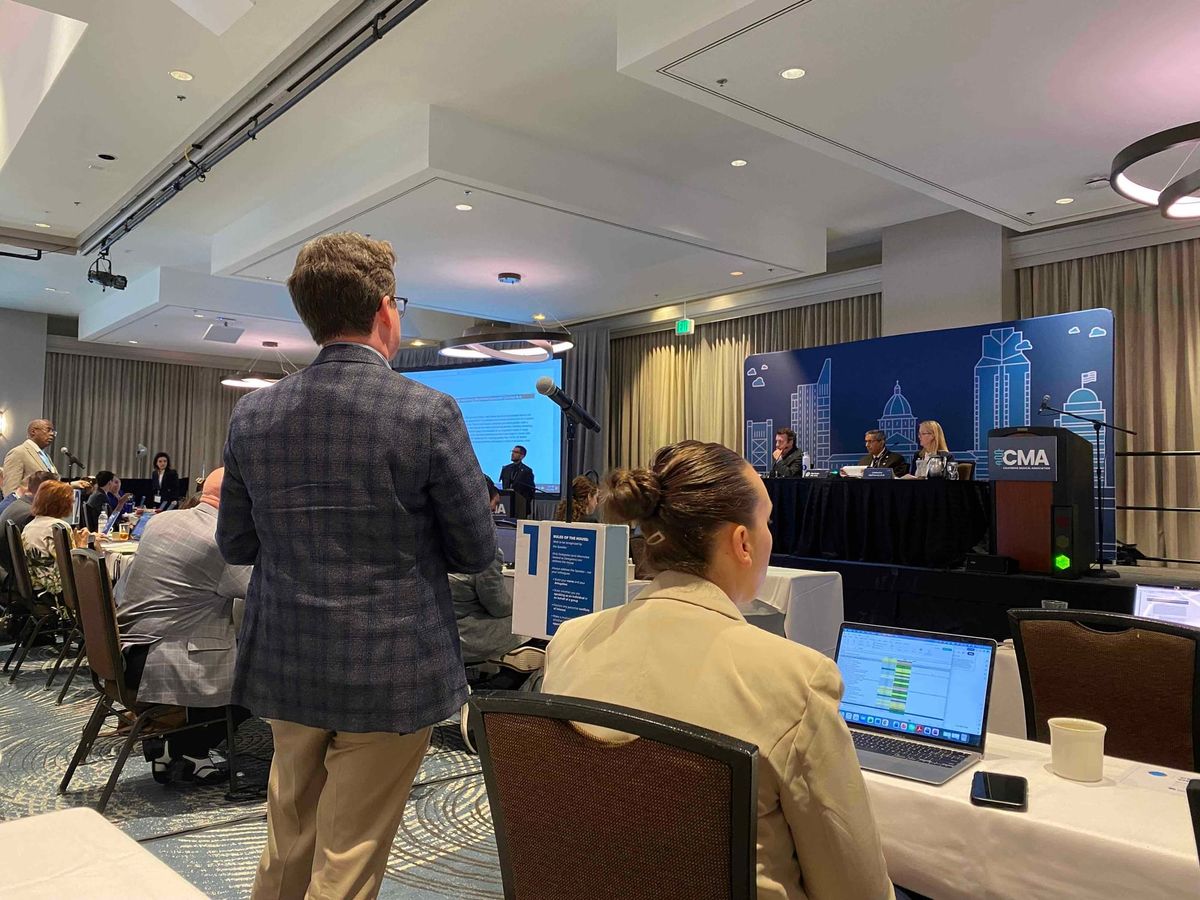
I participate in organized medicine through the California Medical Association, the American Medical Association, and the American Academy of Hospice and Palliative Medicine. Each of these organizations, in different ways, does the same structural thing: it puts me in a room with physicians I didn't choose.
Dermatologists. Rural family medicine docs. Surgeons who think palliative care consults slow down their throughput (or who hate that we did away with experiential pathways into Palliative Medicine...I know, Luke!). Psychiatrists working in systems so broken they make hospice reimbursement look functional. Retired physicians with strong opinions about how things used to work. Early-career physicians with strong opinions about how things should work. People whose politics I find bewildering and who find mine equally so.
I cannot block them. I cannot scroll past them. I cannot algorithmically sort them into a category that I never have to engage with. I have to make an argument, hear a counterargument, lose a vote, and then sit next to the person who beat me at dinner. And then come back the next morning and do it again.
That is not a flaw of the process. That is the process. And it builds something that almost nothing else in a modern physician's professional life builds.
Agency Over Moral Distress
Moral distress — the experience of knowing the right thing to do but being structurally unable to do it — is endemic in medicine. If you practice palliative care, you know this in your body. You've watched patients suffer because of prior authorization delays. You've seen families crushed by a system that treats serious illness as a billing event. You've felt the specific helplessness of understanding exactly what's wrong and having no mechanism to fix it.
The standard interventions for moral distress are, to be blunt, inadequate. Resilience training. Wellness apps. Debriefing sessions. Yoga in the break room. These treat the symptom — the distress response — while leaving the cause untouched. The cause is structural. It lives in policy, in payment models, in regulatory frameworks, in institutional incentive design. And if the only tools you have for addressing structural problems are individual coping mechanisms, you will cope your way into burnout.
Organized medicine gives me a different tool. A slow one. An imperfect one. But a structural one: the ability to participate in changing the systems that create the distress in the first place.
You can write a resolution. You can testify before a reference committee. You can put your patient's story about access barriers into a letter to regulators. You can participate in shaping a lobbying priority that becomes a bill that becomes a law. CMA's wins in the most recent California legislative cycle — new authority to eliminate prior authorization requirements on a code-by-code basis, strengthened protections against corporate interference in clinical judgment — didn't materialize from institutional goodwill. They came from physicians who showed up, year after year, in rooms where policy gets drafted and debated and amended and passed.
That is not wellness theater. It is structural agency. The distinction matters. Wellness theater asks you to feel better about a system that remains unchanged. Structural agency asks you to change the system, even if the process of doing so is slow enough to make you want to scream.
Cross-Pollination You Can't Get in Your Own Silo
Palliative care's problems are not unique. They are local expressions of problems every specialty faces: workforce shortages, payer dysfunction, regulatory burden, scope encroachment, equity gaps in access and outcomes. But if you only talk to palliative care people about palliative care problems — and I do this constantly, it is an occupational hazard — you miss the structural patterns. You see your problem as special when it is actually a variation on a theme.
Organized medicine breaks that silo open by forcing you into conversations with specialties whose problems illuminate your own from angles you'd never encounter inside your subspecialty.
The point is not that organized medicine teaches you about other specialties as an intellectual exercise. The point is that the patterns become visible only when you're forced into proximity with people whose problems are structurally similar and experientially alien. That combination — structural similarity, experiential distance — is what produces insight. And it doesn't happen on a podcast or in a journal article. It happens in a committee room at 6:30 in the morning (EAST COAST TIME!) when someone from a specialty you've rarely thought about describes a problem you recognize as your own.
Community That Survives Disagreement
Physicians have networks. What most physicians don't have is community — and the distinction is not semantic.
A network is transactional. You enter it because you share an interest, a credential, a project. When the interest fades or the project ends, the connection dissolves. A community is something different. It persists through disagreement. It includes people you didn't choose and probably wouldn't choose. It requires you to maintain relationships with people who voted against something you care about, and to do so not because you've forgiven them but because you share a project that's larger than any single policy fight.
Most of the people I keep running into at the AMA House of Delegates — year after year, across different issues, different political climates, different stages of our careers — are not my friends in the social media sense. Some of them I disagree with on questions I find fundamental. But they are people with whom I share a sustained commitment to the same institutional project: making the practice of medicine more functional, more humane, more survivable. We've lost votes to each other. We've made arguments that didn't carry the room. We've sat together afterward and eaten mediocre hotel food and kept talking. That persistence through disagreement is what makes it community rather than a mailing list.
The decline of spaces that require physical presence with people you didn't choose isn't just a cultural curiosity or a men's-health footnote or even really about men. It is a structural loss with specific consequences. Fraternal organizations, civic clubs, religious congregations, union halls — the infrastructure for productive disagreement has been hollowed out across American civic life. Organized medicine is one of the few remaining professional spaces that still functions this way. Not because it was designed to solve the problem of civic atomization, but because its governance structures — House of Delegates models, reference committees, multi-specialty delegations — were built in an era when showing up in person and arguing with people you couldn't avoid was simply how things got done. The structures persist. And they still do the thing they were built to do, even as the rest of civic life has "optimized" that thing away.
Who Gets to Be in the Room
I'd be writing a less honest version of this argument if I didn't address the obvious problem: the room you can't curate has, for most of its history, curated itself.
Organized medicine's leadership pipelines have been disproportionately white, male, and older for as long as organized medicine has existed. Just look at the founding purpose of the National Medical Association for one case-in-point. The reasons are structural, not accidental: participation requires time, travel, institutional sponsorship, and financial flexibility that are not equally distributed across the profession. A rural family medicine physician with a panel of 2,500 patients and two weeks of vacation doesn't have the same access to the AMA House of Delegates as an urban subspecialist with institutional support for professional development. A physician who is a single parent, who carries disproportionate educational debt, who practices in a setting without locum coverage — these physicians face barriers to participation that have nothing to do with interest and everything to do with resource.
The result has been predictable: the spaces where physician voices shape policy have historically over-represented the physicians who already had the most power and the fewest structural barriers. That is a genuine problem, and it undercuts the "uncurated room" argument if you take it at face value. A room that systematically excludes certain voices is curated — just not by algorithm. It's curated by economics, by geography, by the accumulated weight of who has historically been welcome and who has historically been tolerated.
Here is where I want to be precise, though, because the story is not static. The demographics of these bodies are moving. Not fast enough — I don't want to oversell this — but materially. CMA's delegation increasingly includes early-career physicians, physicians of color, and women in leadership roles that would have been unimaginable a generation ago. AAHPM's board and committee structures have become meaningfully more diverse in composition and in the range of practice settings represented. The AMA's strategic plan explicitly names health equity and workforce diversity as organizational priorities, and while strategic plans are not the same as outcomes, the direction of movement is real.
The analytical move here isn't to wave away the exclusion problem with "it's getting better." It's to hold two things at once: the structural value of uncurated professional community is real and that value is diminished when the community itself is shaped by exclusionary access. The answer to both truths simultaneously is not to abandon these spaces. It is to change who's in them — and to build the institutional supports (travel funding, locum coverage, protected time, mentorship pipelines for underrepresented physicians) that make access a structural commitment rather than an aspirational bullet point. The room you can't curate only works if the room is genuinely open.
Where I Might Be Wrong
A few things that would change my calculus or that I'm not fully certain about:
- The time cost is real. These meetings are long. The process is slow. The politics are maddening. Physicians who opt out aren't irrational — they're making a resource allocation decision, and for many, the ROI is genuinely unclear. I have enjoyed, since I was a medical student, the luxury of institutional support for this work from each of my institutions. Not everyone does, and I don't want to moralize about participation from a position of structural advantage.
- The House of Delegates model may be the wrong mechanism. It is a 19th-century governance structure trying to function at 21st-century speed. There are real questions about whether parliamentary procedure and annual resolution cycles can keep pace with the rate at which policy now moves. I believe the model still works for building the kind of community and cross-pollination I'm describing. I'm less certain it works as a policy-making apparatus in an environment where CMS can change a reimbursement rule faster than a resolution can move through committee.
- I am not a neutral observer. I serve on the AAHPM and SDCMS Boards. I'm a CMA delegate to the AMA. Telling other physicians they should participate in the thing I participate in is a recruitment pitch dressed up as an essay if I'm not careful. My answer is that the benefits I'm describing — agency, cross-pollination, enduring community — are benefits I've experienced directly and that I believe are structurally real, not just personally satisfying. But I want to name the tension rather than pretend it isn't there.
- There may be better rooms. Organized medicine isn't the only space that provides what I'm describing. Interdisciplinary clinical teams, community organizing, faith communities, local school boards — other structures exist that put you in proximity with people you didn't choose and require you to maintain relationships across disagreement. I'm writing about what I know. I don't want the argument to imply that organized medicine is the only path to structural agency and durable community. It's the path I've taken. Others may find theirs elsewhere.
Keep Showing Up
The room you can't curate is uncomfortable by design. It is slow. It is procedural. It is full of people who frustrate you and whom you frustrate in return. It requires you to make arguments you believe in and then lose gracefully when you don't carry the room. It asks you to come back the next day and work alongside the people who outvoted you. It does not optimize for your preferences. It does not filter out the voices you'd rather not hear.
That is what makes it valuable. Not despite the discomfort — because of it.
If you are a physician experiencing the systems that govern your practice as things that happen to you; if the only professional communities you belong to are the ones you selected because everyone already agrees with you; if your response to policy frustration is to complain in a group chat rather than testify before a committee, edit a letter to a regulator, or call your Member of Congress — something structural is missing from your professional life. Not a wellness intervention. Not a networking opportunity. A room where you have agency over the systems that create your distress, exposure to problems that illuminate your own, and community that survives the disagreement.
Find the room you can't curate. And keep showing up. Even when the coffee is atrocious.
I am a palliative care physician, educator, and professional strategery expert. Known for turning rounds into rants and rants into teaching points. Rounds & Rants represents my views — not those of any institution or professional membership organization where I hold a role. I don't write on their behalf and they don't vet what I publish.